Is there value in preserving existing forms of social housing?2026
Rather than representing a commitment to housing provision, deteriorating estates increasingly came to signify a safety-net of last resort with a confronting and stigmatised public display of poverty.
After the Death of Modernism, the deteriorating quality of Melbourne's public housing towers shifted their symbolic meaning from a reminder of social security to a social warning. Rather than representing a commitment to housing provision, deteriorating estates increasingly came to signify a safety-net of last resort with a confronting and stigmatised public display of poverty (Pawson et al. 2025).
An artist’s sketch of Park Towers published under the headline “Australia’s Highest Pre-Fabrication Building Taking Shape at South Melbourne” (Housing Commission News, March 1968)
Despite representing Melbourne’s largest scale example of post-war pre-fabricated systems architecture, the high-rise redevelopment project treats the public housing towers as disposable assets rather than historically significant structures (Pawson et al. 2025). The absence of heritage protection reflects a reluctance to recognise public housing as part of the city’s cultural heritage. While Heritage Victoria notes that landmark status alone does not necessarily satisfy contemporary heritage criteria, arguing that the towers’ value does not resonate across the ‘broader Victorian community’; the National Trust of Australia (Victoria) has advised that demolition should be preceded by a comprehensive assessment of the towers’ heritage values, emphasising the significance of places that reveal Melbourne’s social and political history. The high-rise redevelopment reframes buildings that once embodied state-led social provision as obsolete infrastructure and a failed planning experiment (Sisson 2024), legitimising ‘slum clearance’ and creating what Lawrence J. Vale (2013) describes as ‘twice-cleared communities’, a term referring to a cyclical pattern of redevelopment in which the same sites undergo successive waves of mass displacement and clearance to enable new housing models.
The redevelopment model replacing the towers reflects what Rowland Atkinson (2021) describes as the logic of the Alpha City, where cities compete for investment through continuous cycles of redevelopment, land value extraction, and economic growth. Within this framework, public housing estates are increasingly viewed as underutilised assets occupying valuable inner-city land, creating pressure to justify redevelopment and ribbon-cutting politics that favour visible new construction (Atkinson 2021, Kunjan et al. 2026). Contemporary design principles that prioritise tenure-blind housing, ‘conventional’ neighbourhood character, and ‘contextual development’ seek to make social housing visually indistinguishable from private housing (Pawson et al. 2025). While presented as a strategy for reducing stigma, these developments often reproduce social separation through features such as segregated courtyards (Watt 2021). Consequently, urban renewal does not simply replace ageing buildings; it replaces highly visible public landmarks with sanitised, market-led spaces; obscuring the erosion of housing as a social right behind contemporary aesthetics, growth narratives, and the pursuit of investment-led urban development.
· urban planning
Åreknuteknyterne by Åreknuteknyterne2026
1. Untitled (2025 Remaster) 07:33 (2025)
· artist spotlight
Environmental Conservation through a Human-First Approach2026
"Design that provokes a sense of wonder or play may itself be interpreted as a cue to care." Land of Sweeping Plains (2015)
The Victorian National Parks Association (VPNA) recently opened applications for a student placement with the Grassy Plains Network and it got me thinking about the cultural and aesthetic appeal of native grasslands, and the role that design has to play.
Effective urban nature conservation depends on strategic planning that places ecological systems at the centre of decision-making from the earliest stages of development. The centre, not just geographically or logistically, but aesthetically and sociologically. Through central design, active frontages, and social interactivity, planners and designers can protect remnant ecosystems by intregrating them into the structure of urban life (Williams et al., 2015; Marshall & Williams, 2019). By recognising that meaningful ecological relationships are developed through repeated experience rather than passive observation, designing for community stewardship develops connection to place. Nassauer’s (1995) concept of ‘cues to care’, where visible signs of maintenance, thoughtful design and human investment communicate that natural areas are valued by society. By framing ecological landscapes as places that belong within everyday life, planners encourage residents to develop empathy towards both the environments they inhabit and their own relationship with place, time and ecological change.
This framework loops into a concept I began exploring in 2025, which is the idea of using humans as a conservation flagship species. Instead of appealing to empathy in the protection of a vulnerable species, by positioning human beings as the keystone species, it posits us as fundamentally apart of nature, effected both positively and negatively alongside it. By using the framework of ecosystem services, which is designed to put a ‘human face’ on conservation, it can be demonstrated that environmental protection affects anyone who relies on clean water, breathable air, or a stable climate, providing a common language and goal for understanding (Chan et al., 2017). Native ecosystems provide essential regulating services, including stormwater infiltration, urban cooling, carbon sequestration and habitat for pollinators; demonstrating that biodiversity functions as critical urban infrastructure rather than simply open space (Bengtsson et al., 2019; Soanes et al., 2019). At the same time, regular contact with nature improves psychological wellbeing, restores attention, reduces physiological stress and strengthens social cohesion, while distinctive remnant landscapes foster local identity and long-term community investment (Terrapin Bright Green, 2012; Kellert, 2018). These ecological and social benefits are complemented by measurable economic outcomes, including higher property values, improved workplace productivity and reduced healthcare costs (Terrapin Bright Green, 2012; Marshall & Williams, 2019). Integrating biodiversity into the everyday experience of urban life therefore extends beyond environmental protection alone. By designing landscapes that ask people to participate in their care, urban planning can cultivate a culture of stewardship in which conservation becomes an ordinary part of daily life, allowing both human communities and ecological systems to persist together over time (Nassauer, 1995; Marshall & Williams, 2019).
· urban planning
Buffel Grass and Novel Ecosystems2026
"It's too dry now, the summer is too hot. The buffel grass is everywhere." Aunty Pat (2022)
I recently travelled to the Uluṟu-Tjuta National Park on the A87 Stuart Highway. The road takes you from Adelaide and heads north, where rolling hills give way to mallee then mulga, a horizon of desert scrub atop red earth. But at a certain point, around the border between South Australia and the Northern Territory, the red earth disappears beneath a sea of grass. A grass that had never had roots in Australian soil until 70 years ago, a grass that’s looking like it’s here to stay.
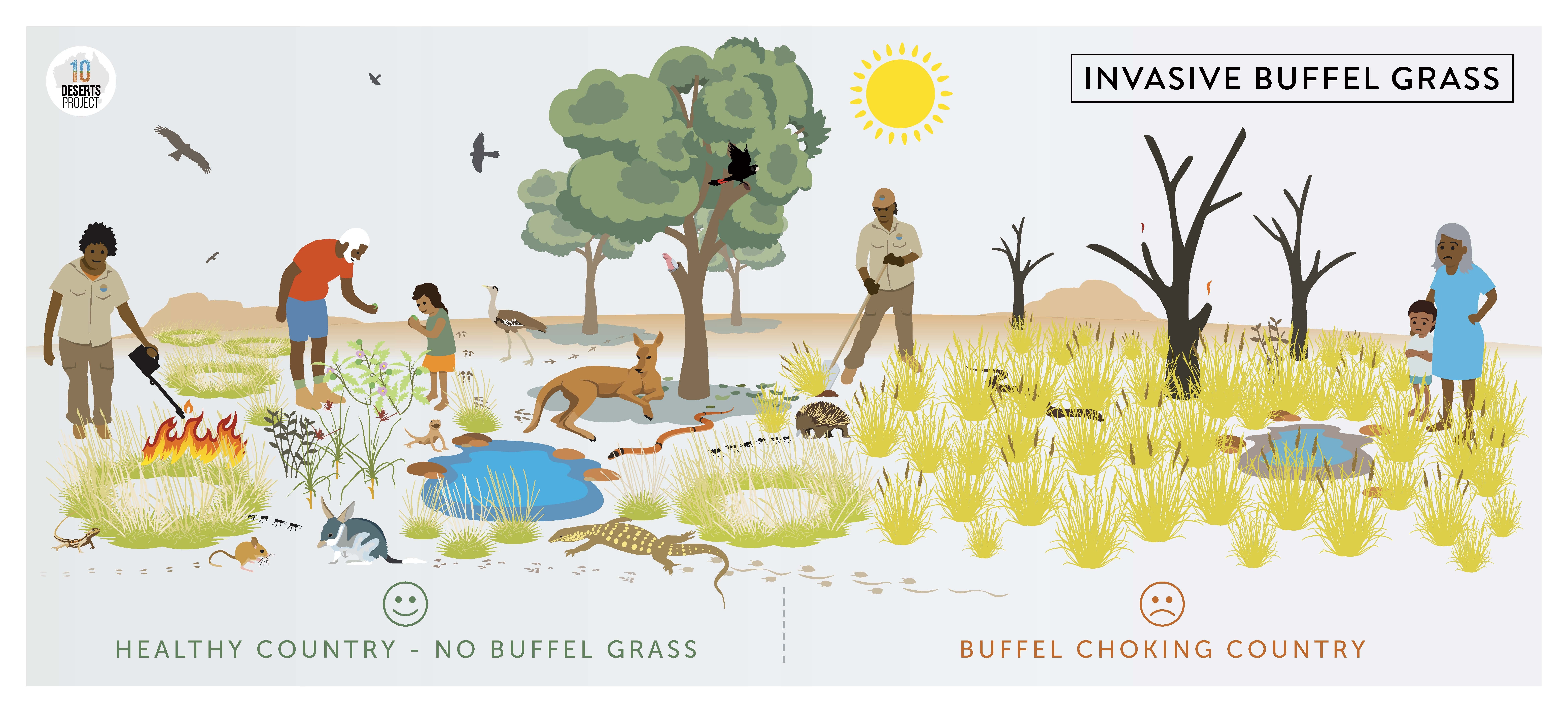
10 Deserts Project, Indigenous Desert Alliance
Buffel grass (Cenchrus ciliaris) is an invasive perennial C4 (a highly efficient processor of water, CO2, and nitrogen) grass native to parts of Africa and western Asia that was deliberately introduced into Australia from the late 1950s for cattle forage and dust suppression (Read et al., 2020; Ryan-Colton et al., 2024). Buffel grass is now widespread across Australia’s arid and semi-arid regions, where it is recognised as a transformer species because it fundamentally alters ecosystem structure and function (Read et al., 2020). The plant creates a grass–fire cycle by producing dense fuel loads that increase the frequency and intensity of fire, causing widespread mortality of fire-sensitive native vegetation such as mulga woodlands and ensuring its dominance through this positive feedback fire-regime that allows it to rapidly spread.
(Read et al., 2020; Ryan-Colton et al., 2024). These ecological changes threaten the biodiversity of over 70% of the country, including protected areas such as Uluru–Kata Tjuta National Park where broadscale management remains prohibitively expensive and technically difficult (Read et al., 2020).
Novel ecosystems are ecological systems that have been fundamentally altered by human activities, resulting in new combinations of species and ecosystem processes that can persist without ongoing human intervention (Hobbs et al., 2013). Unlike hybrid ecosystems, which remain capable of restoration, novel ecosystems have crossed ecological, social or economic thresholds that make a return to their historical state unrealistic (Hobbs et al., 2013). Buffel grass is widely regarded as a driver of novel ecosystems in arid Australia, resulting in irreversible regime shifts from diverse native woodlands to simplified exotic grasslands (Hobbs et al.,, 2013; Ryan-Colton et al., 2024). While some novel ecosystems do eventually integrate native species and achieve functional stability, others can lead to a permanent simplification of the landscape impacting native plants, animals, cultural practices, land use, and ecosystem services. I’d say it’s a bit of gamble.
· urban planning
'The Death of Modernism'2026
“Victoria to replace 44 high-rise public housing towers.”
Melbourne’s 44 public housing towers, constructed primarily between the 1950s and 1980s, emerged
from a post-war belief in the capacity of modernist planning and architecture to reshape society
through rational design and state intervention. Influenced by
the Modernist Movement, the towers were conceived as functional, standardised, and mass-produced
forms of housing intended to replace the overcrowded and deteriorating inner-city ‘slums’ that
had characterised much of industrial Melbourne. Their geometric forms, vertical
scale, access to light, and separation from congested streets were intended to symbolise progress,
efficiency, and a new urban future. In this sense, the towers reflected a broader
modernist ambition to use architecture as an instrument of social reform, replacing older housing
with orderly and technologically advanced ‘machines for dwelling’ that promised improved living
standards for working-class residents.
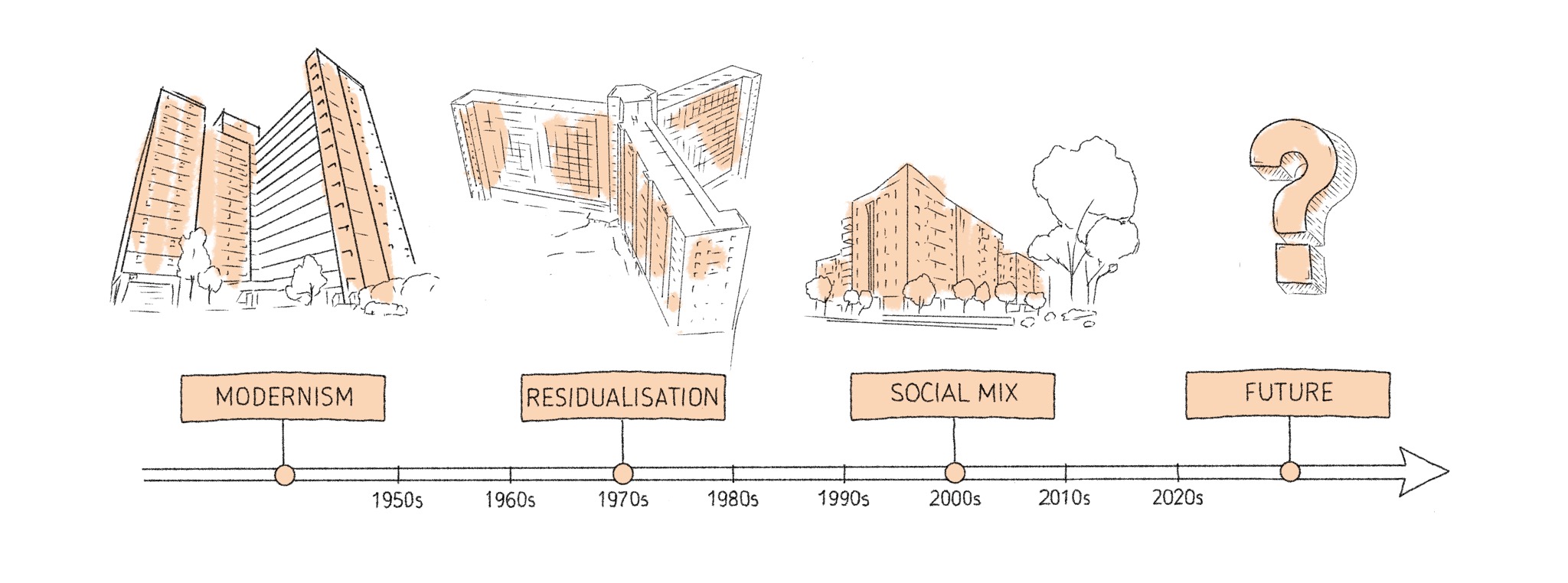
Timeline of Public Housing (2026)
The construction of these estates was closely tied to the economic conditions and policy priorities
of the post-war period. Governments increasingly viewed large-scale public housing provision as
essential infrastructure capable of supporting economic expansion, industrial productivity, and
full employment through direct public investment.
Public housing served the practical function of accommodating returning soldiers, low-income
families, and workers employed within Melbourne’s expanding manufacturing economy, often in
close proximity to industrial employment zones.
Through the 1945 Commonwealth-State Housing Agreement (CSHA), housing provision became a
major component of post-war reconstruction, reflecting a broadly universalist approach.
Rather than functioning solely as welfare housing, public
housing was conceived as a stable and affordable tenure that could support social mobility, family
formation, and long-term economic participation.
Beyond its economic role, public housing was also framed as part of a broader social safety
net intended to provide secure and healthy living conditions for the urban industrial workforce
. The estates were often understood as transitional or stabilising environments
that could act as a ‘springboard’ into greater socio-economic security.
However, while the towers embodied optimism about state planning and modernisation, many of
the assumptions underpinning their design, including the belief that physical form alone could
resolve entrenched social issues, would later become the subject of criticism. By the late twentieth
century, changing political priorities, industrial decline, and the targeting of public housing toward
increasingly disadvantaged populations contributed to the residualisation and stigmatisation of
many estates. This transformation reflected a
broader ideological shift away from post-war collectivist approaches to housing and toward policies
favouring private home ownership, market provision, and reduced state responsibility.
· urban planning
Fred again... & Brian Eno2026
4. Follow 01:39 (2023)
· artist spotlight
Columba livia2026
The rock pigeon (Columba livia), is a member of the bird family Columbidae (doves and pigeons), the only family in the order Columbiformes. The wild type is endangered in many areas, but the domestic and feral pigeons are abundant. Except, they're only abundant where humans are abundant. Their range, their distribution, is 'urban'. They cannot be found 'in the wild'. And while this is partly because the 'wild' does not exist, it is also because, although it can not always feel like it, the human urban environment is a habitat.
"Human structures provide an excellent imitation of cliff structures, making rock doves very common around human habitation. Ideal human nesting attributes combine areas with tall buildings, green spaces, and ample access to human food."
They meet the unique distinction of being a 'var. domestica', bred to coexist with humans; and also finding their natural habitat not only replicated in human designs, but improved. Adjacent to dogs and cats in that they are labelled 'feral', and to magpies and noisy miners that thrive in parkland and greenspaces.
· field notes
Melbourne Conversations: Building the Future Anyway2026
Went along to a Melbourne Conversations event this week on youth climate organising. It was a really refreshing reminder of the passion and spirit that persists amid what can often feel like an unending uphill climb.
The topic felt particularly poignant after attending a lecture by Dr Mittul Vahanvati earlier that day on resilient housing and the increasingly urgent need to treat homes as infrastructure amongst risk from natural and climate-fuelled hazards. The way forward through the Planetary Health approach sticks out to me as a ray of light, and I hope to be building a future with regenerative solutions.
A concept from the panel that was loudly resonant is that power comes from collaboration, experimentation, and wide-eyed ambition; captured by the words from Jean Hinchliffe that "building community is part of the fight for the future."
· urban planning
Notechis scutatus at Wilson's Prom2026
Went to Wilson's Prom and hiked into Oberon Bay this April for a few days of camping. Was thrilled to spot a beautiful Tiger Snake (Notechis scutatus) lounging in the sunny clearing of an empty campsite. While a very dangerously venomous snake, this particular one was very relaxed and unbothered.
Admittedly 'Man still recovering from tiger snake bite at Wilsons Promontory' was not my favourite first result to see when confirming my ID.
· field notes
Melbourne Insect BioBlitz2026
From 1 to 7 March 2026, the City of Melbourne ran an Insect BioBlitz, encouraging people to take a moment, step outside and look closer at the world around them.
It was lovely to open my eyes to the effort actively happening all over Melbourne to make the most of our green spaces, and help restore their ecosystemic services. The Melbourne Pollinator Corridor (MPC), headed by Emma Cutting with Heartscapes, is a project healing the cities connectivity through biodiversity. I was able to take a tour of their new indigenous garden at St Martins Youth Arts Centre. It was so inspiring to see the very real difference that some native plants and a lot of passion had made on even quite a small space. It's an important reminder than even on such a broad scale of ecosystemic health, every loved patch of earth makes a difference.
At the 'Pollinators and plants in the city' event I was even able to see a Blue Banded Bee (Amegilla cingulata) and a Neon Cuckoo Bee (Thyreus nitidulus) in the Queen Victoria Gardens, just over the river from Fed Square.
Only a few weeks after the event I wound up finding my first native bee in my own little garden, a ground-nesting metallic sweat bee. It brought me such joy to know that what had once been a tumble of grass and blackberries was now supporting a native ecosystem.
· field notes
Marlow Moss2026
“I am no painter, I don't see form, I only see space, movement and light.”
- Marlow Moss
Marlow Moss is a figure of great significance to the histories of modern art, and the LGBTQ+ community specifically. They were a London-born British artist who undertook her seminal training in interwar Paris, and was closely associated with the Neo-Plasticist Piet Mondrian. Much of Moss’s work was lost in the shelling of the artist’s Normandy home in 1944. Throughout their life and career, Moss embraced queer modes of appearance, art making and being, from their open relationships with women to their preference for androgynous dress.
“I destroyed my old personality and created a new one.”
- Marlow Moss
I attended the Beyond the Binary talk at the NGV, hosted by Meg Slater and Laura Castagnini. They spoke about the artist's life and career, but what I found most interesting was the discussion around pronouns and historical interpretation.
Moss would never have used they/them pronouns because that language simply was not available at the time. Some historians therefore choose to use she/her, as those were the pronouns used throughout Moss's life. Others argue that, because Moss essentially lived as a man, they/them pronouns are a more appropriate way of acknowledging that reality.
What stood out to me was the discussion about writing the artwork label itself. The NGV currently uses she/her pronouns because that is what most of the historical literature uses. The challenge is finding a balance between established academic usage and contemporary public understandings of gender and identity.
· artist spotlight
Old Saw2026
3. Dirtbikes of Heaven, Grains of the Field 07:31 (2021)
· artist spotlight
Status Anxiety2026
“What Orwell feared were those who would ban books. What Huxley feared was that there would be no reason to ban a book, for there would be no one who wanted to read one.”
- Amusing Ourselves to Death, Postman (1985)
Aldous Huxley’s Brave New World presents a 'World State' built upon the pillars of 'Community, Identity, Stability', where the population is biologically engineered and psychologically conditioned to accept a rigid caste hierarchy. This societal structure becomes a vivid commentary on the concept of 'status anxiety', a term popularised by philosopher Alain de Botton in 2004, 72 years post the publishing of Huxley's book. Status anxiety is the worry that one is failing to conform to society's ideals of success and that one may be stripped of dignity and respect. In Huxley's vision, the State’s stability is predicated on preventing the trauma of non-conformity by ensuring that individuals are conditioned to be happy with their place from birth.
“Success went to his head, and in the process completely reconciled him to a world which, up until then, he had found very unsatisfactory.”
- Brave New World, Huxley (1930)
Bernard Marx, an 'Alpha Plus' who feels like an outsider to his supposed caste, carries a self-consciousness defined by his admittance, "I am I, and wish I wasn't". He embodies the plight of the individual through his perspective of agony and humiliation in a society beholden to the affections of others admist a culture of image politics. Much like Bernard’s temporary reconciliation with the state during his brief period of celebrity, modern life often pits personal identity against a world that equates professional status with intrinsic human worth. Bernard's struggle highlights the dichotomy of the self, and the social-political tension that persists in any hierarchical society.
I'm reminded of David Finch's work, Do You Feel Important?
· culture
Steve Reich2026
9. Section VII 04:19 (1998)
Music for 18 Musicians
Reich (1976)
· artist spotlight
A throwback to Modernism2025
“The city is profoundly rooted in the realms of calculations. Engineers, nearly all of them, work for the city. And through them the necessary equipment for the city will come into being. This is the essential thing for that part of it which is utilitarian and consequently ephemeral. But it is the city’s business to make itself permanent.”
- Le Corbusier, The City of To-morrow and its Planning (1929)
Le Corbusier was a French-Swiss architectural designer, painter, urban planner and writer who was one of the pioneers of what is now regarded as modern architecture. His radical urbanism was driven by a profound belief in the power of design and reconstruction to resolve a deep-seated social and urban crisis. Foundational in the mission to bring forth a emerging era for humankind was the belief that order in the built environment was intrinsically linked to human psychological and spiritual well-being, leading to harmony and happiness. His goal was spear-headed mission to restore serenity and joy through pure, geometric forms. It didn't entirely pan out that way, and it could be argued that it was doomed to begin with. A visionary trying to find a dictator to realise his plans - a Haussman trying to find his Napoleon, it was never going to be popular.
Nowadays it feels like that Machine Age utopian idealism has been worn down, discarded, and even lost to time. The belief that you really could engineer a better society at scale has given way to contemporary imaginings of predominantly dystopian futures. From Aldous Huxley’s 1932 Brave New World and George Orwell’s 1949 Nineteen Eighty-Four, Ridley Scott’s 1982 Blade Runner and Godfrey Reggio’s 1982 Koyaanisqatsi, and Suzanne Collins’ 2008 The Hunger Games and Charlie Brooker’s 2011 Black Mirror; the prevalence of progress narratives has been replaced by a dominance of collapse narratives. Perhaps in the way that utopia as a universal blueprint of perfection no longer serves us, a way forward can be found through incremental solutions to our collective problems.
· urban planning
'enlightened' social control2025
“Alone, I would never have been able to pursue, nor especially to bring to its successful conclusion, the mission that [the emperor] demanded of me. I merely carried it out.”
- Georges-Eug`ene Haussmann, Memoires (1890)
Louis Napoleon (III) was exiled from Paris at the age of seven, following the fall of his uncle Napoleon Bonaparte (I). His motivations and ideologies would have been framed by a desire to rebuild and maintain the power of the Bonaparte dynasty, and by a dream to transform Paris into a modern capital. The big problem for growing European cities was how to control them; and so the goal was to achieve social order and stability by seemingly addressing the dire material needs of the poor (liberation/reform) while simultaneously eliminating the political and geographical conditions that enabled their revolutionary potential (control). Through strategic reorganisation of the urban environment through physical cleansing and spatial containment of the working class, coupled with ideological efforts aimed at moral transformation through housing reform, there was a constant consideration of mechanisms of social control.
As emperor, Louis Napoleon held the overall vision for rebuilding Paris. He secured the legal basis for the works by deciding that all 'public' works would be done by imperial decree and eliminating the position of the mayor of Paris. Haussmann was appointed as prefect of Seine in 1853 and became Napoleon's 'dedicated right-hand man', the instrument of the emperor who would bring his master plan to fruition. Napoleon was deeply preoccupied with the strategic aspect of urban planning; broad boulevards replaced narrow, winding streets that had been the source of barricades and insurrection, combined with barracks at strategic road intersections to ensure 'order would always have the upper hand'. The idea of redesigning the city for public health was built upon established rhetoric that poverty, crime, and working-class militancy stemmed from workers' 'moral degeneration' and thus a justification was provided for the changes that enabled the environmental social control.
· urban planning
Jenny Holzer2025
“BECAUSE THERE IS NO GOD SOMEONE MUST TAKE RESPONSIBILITY FOR MEN.
A CHARISMATIC LEADER IS IMPERATIVE.
HE CAN SUBORDINATE THE SMALL WILLS TO THE GREAT ONE. HIS STRENGTH AND HIS VISION REDEEM MEN. HIS PERFECTION MAKES THEM GRATEFUL.
LIFE ITSELF IS NOT SACRED, THERE IS NO DIGNITY IN THE FLESH.
UNDIRECTED MEN ARE CONTENT WITH RANDOM, SQUALID, POINTLESS LIVES.
THE LEADER GIVES DIRECTION AND PURPOSE. THE LEADER FORCES GREAT ACCOMPLISHMENTS, MANDATES PEACE AND REPELS OUTSIDE AGGRESSORS. HE IS THE ARCHITECT OF DESTINY. HE DEMANDS ABSOLUTE LOYALTY. HE MERITS UNQUESTIONING DEVOTION. HE ASKS THE SUPREME SACRIFICE. HE IS THE ONLY HOPE.”
- Jenny Holzer
Jenny Holzer began flyposting her Inflammatory Essays across New York City in the late 1970s. Every week she would hang new posters in different colours and locations, each sheet presenting 100 words arranged into 20 lines. These provocative statements adopt a variety of extreme political and moral positions. They do not reflect the view of the artist, and are not even consistent with each other. Holzer crafted the texts herself, drawing from a vast array of ideological sources; from political to religious, fascistic and dictatorial to literary and liberal. She intended the posters to stop passersby in their tracks, confronting abuse of power, sexism, consumerism and violence entrenched in both societal structures and personal relationships.
I first encountered Jenny Holzer's 'Inflammatory Essays' in 2018 at the Tate Modern in London, but it was not until I encountered them for the second time in 2025 at the National Gallery of Australia in Canberra that I felt the intention and execution resonate with me. The use of capital letters demand acknowledgement, promsies that the words have meaning and a right to be heard.
· artist spotlight
M2050 People's Panel2025
“The Panel will bring together a representative sample of the City of Melbourne community, to deliberate on the key issues and opportunities facing Melbourne, to support council decision-making on strategic priorities and outcomes for the Vision 2050, Council Plan and aligned strategies.”
- Council Strategic Planning Program, 2025
In May 2025, I was chosen to be one of 50 people representing Melbourne in the M2050 People's Panel.
The Panel adopted eight principles, which capture what we wantd Council to keep in mind while making decisions. With more detail provided in the City of Melbourne Council Plan 2025-29, they are as follows:
1. Future-focused resource stewardship
2. Deepening connection to Country
3. Creativity and innovation
4. Always considering health and wellbeing
5. A people-centred city
6. Future-ready Melbourne
7. Safe and accessible by design
8. Climate action as a collective responsibility
I hope that council action will be guided by these.
· urban planning
A fine place for a grid2025
“It was John Wedge, Batman’s private surveyor, who named the Yarra Yarra. In September 1835 he was at the Turning Basin with some Kulin and heard them identify the river as it came over the Falls as, he wrote, ‘Yarrow Yarrow’. It was only some months later that Wedge discovered they had been referring to the pattern and movement of water over the Falls, not the river itself.”
- Kristin Otto, Yarra: A Diverting History (2005)
I think a lot about the destructio of the Yarra Falls. The Falls, called Yarra Yarra, were important to the local Aboriginal nations, the Woiwurrung and the Boon Wurrung, who used it as a crossing point between their lands in order to negotiate trade and marriages. It was a rough, basalt ledge with a one metre drop, spanning the river where Queens Bridge and Market Street are today. In 1879 Sir John Coode declared that the Falls must be demolished in order to prevent a repeat of previous floods, and in 1883 they were destroyed with dynamite. Like oil and water, two philosophies clashed; so foreign they could barely comprehend each other.
Melbourne from the Falls, Robert Russell (1837)
· urban planning
What are ecosystem services?2025
“A thriving and swimmable Birrarung, from source to sea”
- The Swimmable Birrarung Initiative
Ecosystem services are the processes through which natural ecosystems and their inhabitants sustain and benefit human life. They consist of provisioning, regulating, and cultural services that rely upon supporting services. Their combined products allow for human health, security, and wellbeing by providing food, drinking water, climate resilience, recreation, and aesthetics.
Many of these service benefits may not be visible between communities or locations, or even on human timescales. The central concern is to make the dependency on the health of the ecosystems visible with tangible goals that benefit humans in a personal way. Measuring the project by the ability to swim in the river, a concept so removed from city culture it is considered 'wild' freshwater swimming, would make a river restoration project's success undeniably obvious; but will not address the larger systemic issues of Indigenous water rights, the Port Phillip Bay marshland, and the disruption of the vast network of billabongs surrounding the Birrarung.
The City of Melbourne declared a climate and biodiversity emergency in 2019, acknowledging the risks posed heat, floods, bushfires, and storms. A healthy river ecosystem would provide climate regulation services by mitigating biodiversity loss, flooding risk, urban heat, as well as preventing land value loss and tourism based economic downturn. A regenerated Birrarung would see the integration of nature-based solutions that create resilient and equitable cities, meeting crucial environmental action for human benefit.
The Birrarung is alive,
has a heart, a spirit and is part of our Dreaming.
We have lived with and known the Birrarung since the beginning.
We will always know the Birrarung.
- Yarra River Protection (Wilip-gin Birrarung murron) Act 2017
· urban planning
The Greenline Project2025
“City of Melbourne blames state and Commonwealth for stalled Greenline development on the Yarra River”
- ABC News, May 11 2025
The Greenline project, announced in 2022 by the then-Lord Mayor Sally Capp, is a 4km long ecological restoration project that would transform the northern bank of the Yarra, with boardwalks and parks, along with floating wetlands and native insect, bird and fish habitats, stretching from Birrarung Marr to the Bolte Bridge.
“Melbourne’s Greenline Survives Bid to Shelve Project”
- The Urban Developer, May 20 2025
It always seems to come down to funding. Big promises that fall through when the money dries up.
I hope that as the idea of swimmable rivers in cities spreads, and the Swimmable Birrarung project picks up speed, we will see a renewed push for the Greenline project. A public outcry against the outdated treatment of our river, and a consensus that restoration is essential, will hopefully be the ticket for funding.
“As Paris opens permanent Seine bathing sites this summer, grassroots groups from Berlin to Melbourne are renewing their mission to realize plans for swimming in local waters, and the Swimmable Cities Summit hopes to swell the tide.”
- Culture of Bathe-ing, March 01 2025
· urban planning
Philip Glass2025
So these are the days my friends
And these are the days my friends
Knee Play 5
Einstein on the Beach, Glass (1976)
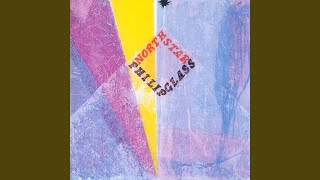
Etoile Polaire — North Star
Glass (1977)
· artist spotlight
Farming? Not In My Backyard2025
The term 'countryside' invokes an imagined rurality that, if it ever existed, often disappears beneath the very housing estates that advertise themselves with images of grassy meadows. The agricultural image sought by many peri-urban lifestyle migrants does not fit the reality of industrial large-scale operations.
Industrial agriculture, such as intensive poultry farming, is already a significant feature of Melbourne peri-urban regions, however I feel that entire concept of 'peri-urban' hinges on what the future of farming looks like. Currently, this consists of large-scale, highly concentrated, vertically integrated businesses that require specific locational factors, including proximity to processing plants and access to labour and markets. This style of agriculture is already transitioning to land not viable for broadacre farming. The planning system struggles to articulate a clear vision for these complex, multifunctional spaces and as methods of farming continue to adapt to climate change, resource depletion, and market demands I think it is unlikely to stabilise for some time.
· urban planning
Mike Barr2024
“it's not what you see but what you feel”
- Mike Barr
South Australian based artist Mike Barr paints in an impressionistic style, catching the essence of time and place. His rainy paintings of Melbourne being immediately immersive.
I attended Mike Barr's live painting demonstration at the 2024 Camberwell Art Show.
· artist spotlight
Kali Malone2024
4. Does Spring Hide Its Joy v2.1 20:12 (2023)
· artist spotlight
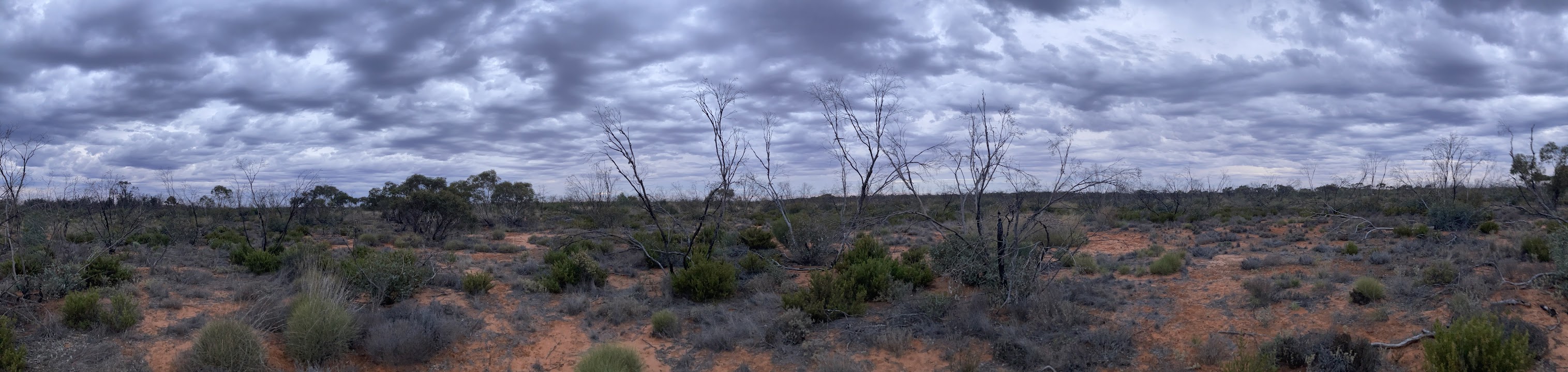
mallee2024
the stars here, i'll never forget the stars
australian mallee (2024)
· field notes
Colin McCahon2024
“I HAVE GLORIFIED IT AND I WILL GLORIFY IT AGAIN”
- Colin McCahon
Occupying the right-hand side of 'Victory over Death 2' is a huge I AM, stretching from the top to the bottom of the canvas, marked out in white paint on black. But before this, McCahon has painted another AM, but this time black on black. The statement becomes a declarative and a doubt.
While McCahon's work is deeply intertwined with religion, it is the intimate dialogue that I find captivating. The open conversation of confidence and uncertainty; to be heard and misheard, spoken to through the despair.
I fell in love with 'Victory over Death 2' at first sight. At 207.5 x 597.7 cm of black background with sharp white text, it commands its space. The central pillar of white, the 'I', splits the canvas in two like a monolith. The artwork feels like a diary page of ideas too big to fit in a journal, an enormous collage of desperate expression. The thoughtful curation of an incredibly raw assertion of emotion feels addictive, like I'm looking at something I'm not meant to, but it's begging me to look.
· artist spotlight
Joshua Burnside2024
1. I Saw the Night 03:54 (2020)
· artist spotlight
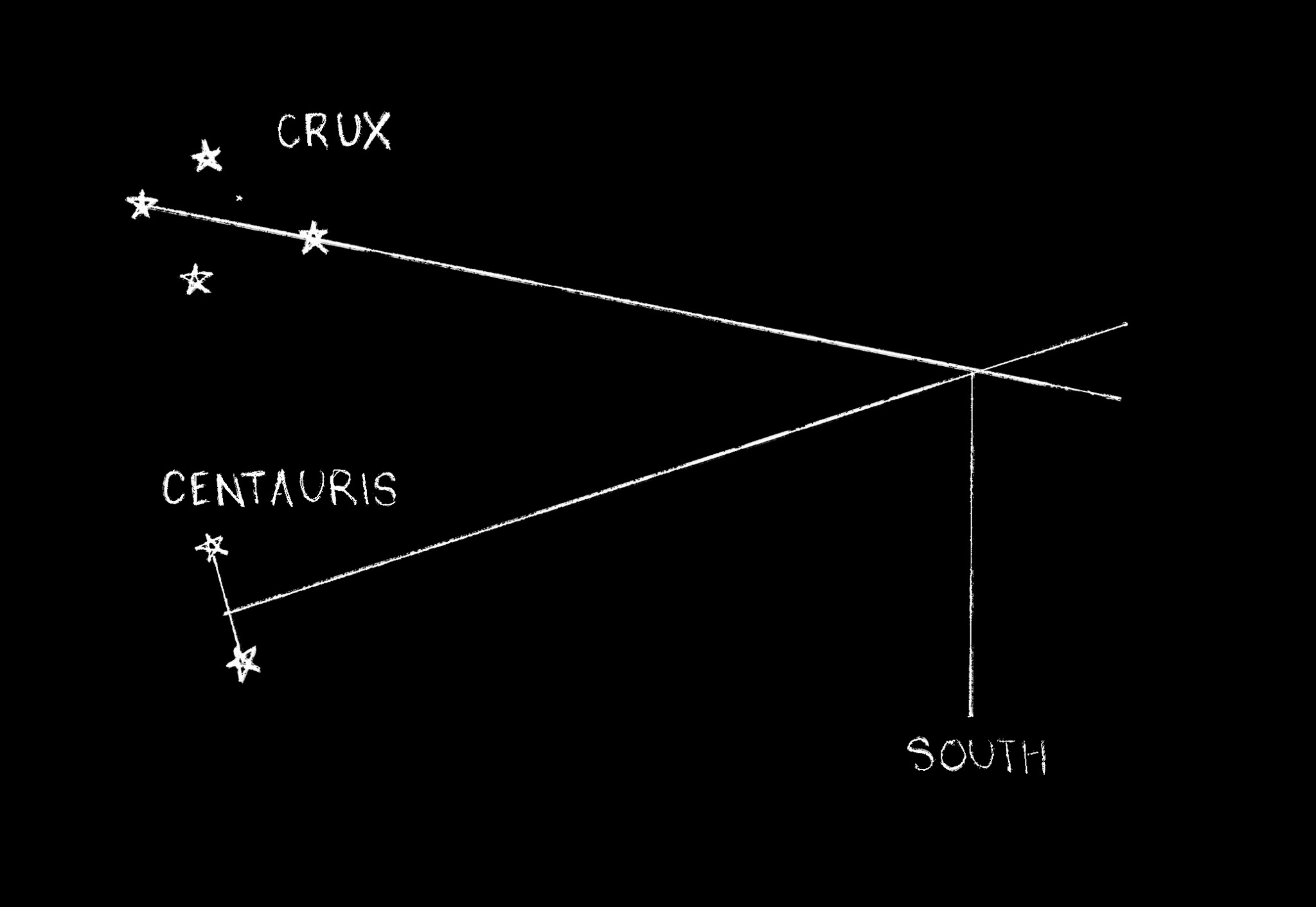
stargazing2024
there is something incredible about about able to orientate yourself using the stars, stars that are unique to your part of the world. It always amuses me to spot our upside-down Orion.
I drew this after a camping trip to Tallarook, by the Goulburn River. My friends and I went camping a lot there that summer. There is something about enjoying the company of others around a campfire that just feels so carnally right.
finding the south celestial pole (2024)
· field notes
bachelor2023
I graduated with a bachelors of computer science today.
· field notes
Space Between Buildings2023
Jan Gehl was born in Copenhagen, achieving a Masters from the School of Architecture at the Royal Danish Academy of Fine Arts in 1960. He describes how his education taught him that the pillars of good architecture is form to the point of sculpture, to design for the eye of the motor vehicle, and to worship ‘Brasilia’, the Modernist’s aerial Holy Grail.
It was the women he married, Ingrid Gehl, a psychologist who asked him:
“Why don’t they teach you anything about people in the school of architecture?”
“Why do you think the [architects] take the photos at 5 o’clock in the morning?
To be sure there’s no people.”
“It twice as high as anything else around. It stood out like some beacon cathedral on a hill.”
- Jeff Copolov
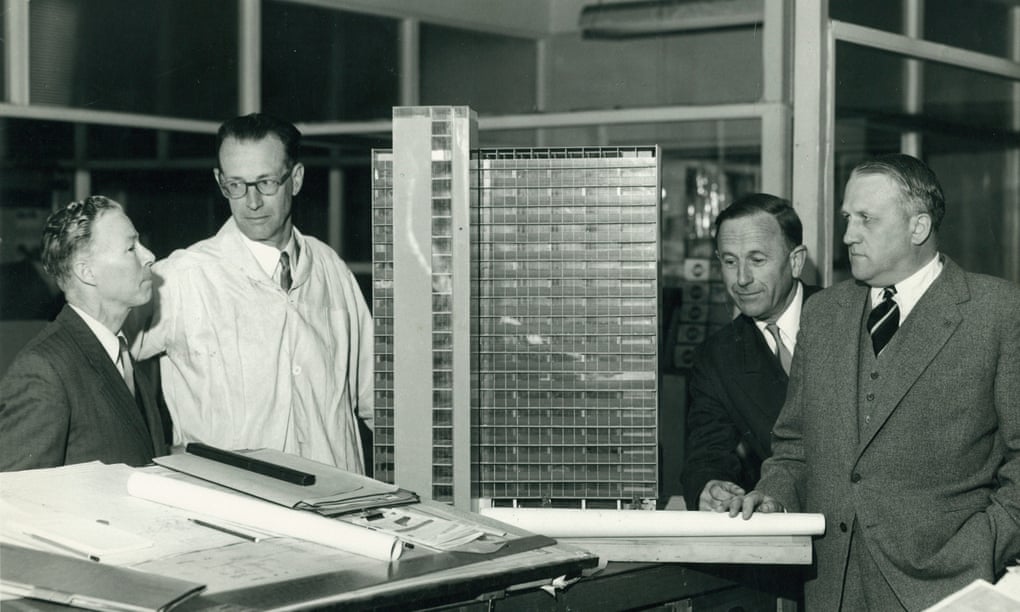
ICI House, renamed to Orica House after its sale in the late 1990s, represents the arrival of Modernist architecture in Melbourne. Designed by Bates, Smart & McCutcheon, its construction between 1956 and 1958 would see Australia witness the erection of what would be its first skyscraper. The building, located on 1-4 Nicholson Street, East Melbourne, was designed in the International Style, with its freestanding fully glazed glass curtain wall. It represented the most refined example of the firm's attempts to perfect the high-rise office design. The ICI house rose to an impressive 22 stories, reaching 81 metres in height; breaking the cities height limit and changing Melbourne's skyline forever.
The previous height limit of 132 feet, or 40 metres, had been set in 1916 by the height that could be reached by fire brigade ladders. To circumvent this restriction, a negotiation was made for the increased height in exchange for offered public spaces: a garden on the ground floor, public car parks, and the cafeteria on the top floor, where most other buildings reserved space for executives. Modernist buildings combining towers and publicly accessible plazas, Collins Place, AMP Square and the state offices at Treasury Place, were following its lead.
Architect Sir Osborn McCutcheon, second from right, with a model of ICI House
The building sits on raised steel faced columns with Italian glass mosaic tiles. It features one wall of brises-soleil, a sun shading structure to reduce the effects of direct sunlight on a building, and its other faces of sheer curtain walls of glass. Its construction signified the use of a number of innovative advancements of technique with the use of Modern industrial materials like concrete and pre-cast units in its structure and flooring, representing truth to materials. The interior design of the building was revolutionary, rejecting historicism with its open plan floor space being flooded with natural light through the transparent glass partitions that separated offices.
The ICI house symbolised progress, modernity, efficiency, and corporate power.
· urban planning
Lebanon Hanover2021
3. Kiss Me Until My Lips Fall Off 04:09 (2018)
· artist spotlight
hitchhiking2018
after trying the deep fried mars bar that Stonehaven is known for, we walked to the last stretch of road before the A90 and stuck out our thumb. almost an hour later we were getting worried, but to our great relief a sweet old man picked us up. he told us all about how he'd climbed every mountain in scotland, how lovely.
· field notes
Mark Rothko2018
“[My paintings] are involved with the scale of human feelings, the human drama, as much of it as I can express”
- Mark Rothko
In 1958, Mark Rothko was commissioned to produce a series of paintings for the Four Seasons restaurant in New York’s Seagram Building. He constructed a full-scale scaffold in his studio to match the proportions of the intended space, allowing the works to be developed in direct relation to their architectural setting. Over the following two years, however, the project shifted in direction. The paintings became increasingly dark in tone, moving away from the luminous colour fields of his earlier work towards deeper reds, maroons, and black. In 1960, Rothko withdrew from the commission, deciding that the social function and exclusivity of the restaurant were incompatible with the contemplative nature of the work.
When I walked into the Mark Rothko room in Tate London it felt like a church, like a sacred space. Two wooden benches in the middle of a dimly lit room with dark grey walls, and these huge imposing canvases glowing under their spotlights. Each piece was an invitation to hear a story, to look into the slice of colour and find somewhere new, yet somehow somewhere you'd been before.
I sat in that room for a long time. It was Black on Maroon 1958 that held me. I went back to see that painting three times that month I was in London. It's hard to describe why that particular formation of colour put its hand around my heart. It felt like a portal, in the same way a really good book is, but when I looked inside I felt like it myself that I was reading.
· artist spotlight
Louise Hearman2017
“The teeth stand like fenceposts by the side of a road, illuminated by headlights.”
- John McDonald (2016)
Louise Hearman’s work operates in a space where familiar imagery is made strange through shifts in scale, context, and light. Her paintings emerge through a process of recombination, where fragments of memory and observation are brought together into surreal windows. The consistent focus on twilight conditions and artificial illumination contributes to a subdued, nocturnal atmosphere, where forms emerge partially from darkness, reinforcing the tension between realism and ambiguity.
I first encountered Hearman's work on May 2017, at the first major museum survey of her work at the TarraWarra Museum of Art, curated by Anna Davis. It was the first time I had truly noticed the effect of curation on the way an artwork feels. Sharp spotlights aimed precisely at each artwork made them glow as if lit from within, as if they were living and breathing, equally existing.
· artist spotlight
nikon dlsr d53002017
On march 2017 I went to a FilmNeverDie Walk and used a DLSR.
It was a hand-me-down from a friend of mine, Thomas, a Nikon D5300. He showed me how to shoot in manual.
I fell in love with digital cameras that day, and that same camera remains the one that I use.
· field notes
LORN2017
2. ANVIL 03:29 (2015)
· artist spotlight
Emily Kame Kngwarreye2016
“She trusted the paint”
- Colm Toibin
Emily Kame Kngwarreye was an Aboriginal artist from Alhalker in the Northern Territory, whose paintings build layered, textured compositions through organic marks and earthy colours, reflecting knowledge of country, culture, and conscious connection.
Kngwarray’s Anwerlarr Anganenty (Big yam Dreaming) is a 3 metre by 8 metre monochrome work, painted continuously over two days. The fluid lines recall her batiks of 1977-88 in which fluid lines are derived from women’s awely ceremonies, a collective form of matrilineal kinship and sharing of knowledge of the land, customs, and Dreamtime stories.
I remember being in awe when I first saw this work. It dominated the gallery, swallowing all else in the veins, sinews and contours of Alhalker. It had the impact of Jackson Pollock's 1952 'Blue Poles', but replaced the bold and glossy splattered enamel with soft sweeping textured stripes. The painting invites you in, consumes you in a rythmic familiarity that feels both comforting and momentus.

.jpg)
(Housing Commission News, March 1968)
Despite representing Melbourne’s largest scale example of post-war pre-fabricated systems architecture, the high-rise redevelopment project treats the public housing towers as disposable assets rather than historically significant structures (Pawson et al. 2025). The absence of heritage protection reflects a reluctance to recognise public housing as part of the city’s cultural heritage. While Heritage Victoria notes that landmark status alone does not necessarily satisfy contemporary heritage criteria, arguing that the towers’ value does not resonate across the ‘broader Victorian community’; the National Trust of Australia (Victoria) has advised that demolition should be preceded by a comprehensive assessment of the towers’ heritage values, emphasising the significance of places that reveal Melbourne’s social and political history. The high-rise redevelopment reframes buildings that once embodied state-led social provision as obsolete infrastructure and a failed planning experiment (Sisson 2024), legitimising ‘slum clearance’ and creating what Lawrence J. Vale (2013) describes as ‘twice-cleared communities’, a term referring to a cyclical pattern of redevelopment in which the same sites undergo successive waves of mass displacement and clearance to enable new housing models.
The redevelopment model replacing the towers reflects what Rowland Atkinson (2021) describes as the logic of the Alpha City, where cities compete for investment through continuous cycles of redevelopment, land value extraction, and economic growth. Within this framework, public housing estates are increasingly viewed as underutilised assets occupying valuable inner-city land, creating pressure to justify redevelopment and ribbon-cutting politics that favour visible new construction (Atkinson 2021, Kunjan et al. 2026). Contemporary design principles that prioritise tenure-blind housing, ‘conventional’ neighbourhood character, and ‘contextual development’ seek to make social housing visually indistinguishable from private housing (Pawson et al. 2025). While presented as a strategy for reducing stigma, these developments often reproduce social separation through features such as segregated courtyards (Watt 2021). Consequently, urban renewal does not simply replace ageing buildings; it replaces highly visible public landmarks with sanitised, market-led spaces; obscuring the erosion of housing as a social right behind contemporary aesthetics, growth narratives, and the pursuit of investment-led urban development.